
Printed Electronics and Graphene for Defense and Space
Voltera V-One and NOVA allow R&D teams to prototype PCBs, antennas, sensors, and wearable electronics in-house—no outsourcing or silicon screens. Graphene heating films and Blackleaf inks protect drones, batteries, and soldier equipment from cold and icy conditions.
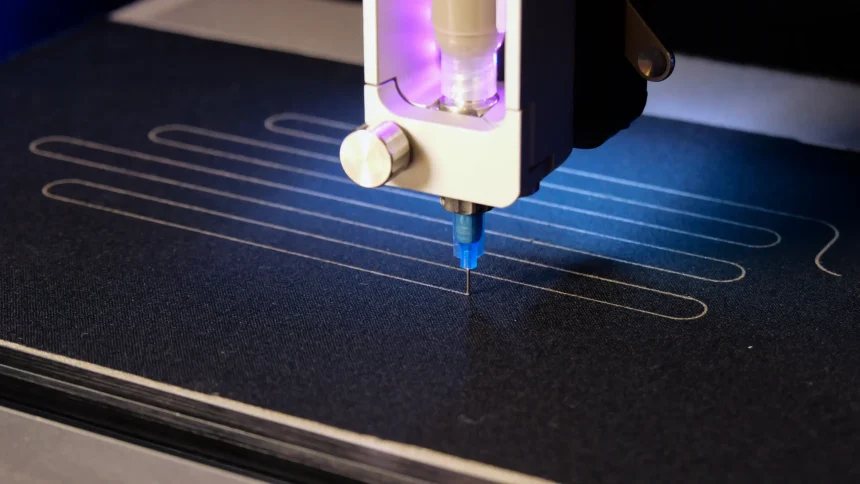
Voltera NOVA prints a heater made of conductive ink directly onto the fabric.
Rapid electronics prototyping for the defense and space sectors
Defense and space projects require multiple iterations of electronics: control boards, antennas, sensors, and heaters. Voltera V-One and NOVA allow you to create these in your own lab, while Blackleaf's graphene materials provide thin, lightweight, and uniformly heated films to protect equipment from cold and icy conditions.
Prototype in place
V-One and NOVA print boards, antennas and sensors in their own lab – without sending documentation to an external PCB manufacturer and without waiting for delivery.
Technical and textile substrates
NOVA applies materials to cotton, nylon, Kevlar®, TPU, PET, polyimide (Kapton) and paper, while V-One applies materials to rigid laminates such as FR1.
Multi-layer printing
Conductive layers, dielectrics, electrolytes and phosphors stacked one on top of the other – from thin batteries to electroluminescent displays.
Graphene foils instead of metal heaters
Blackleaf heating foils are 50–300 µm thick and have a minimum bend radius of 2 mm, and they heat evenly over the entire surface – including the curves of wings and housings.
Electronics for satellites and space missions
CubeSats, research payloads, and technology demonstrators undergo multiple electronics iterations before they reach environmental qualification. At Voltera, test boards, antennas, microheaters, and interconnects are built in the lab on the same day, allowing the team to immediately test the next version of the design.
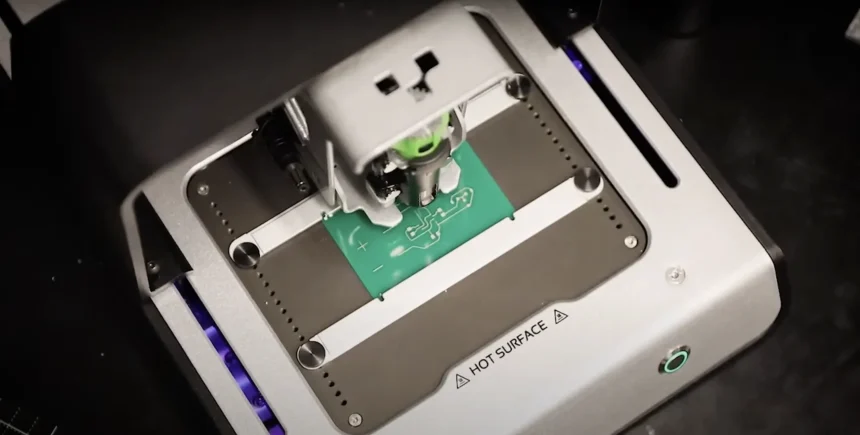
Princeton University – CubeSat Electronics
Mechanical and Aerospace Engineering students prototype PCBs for CubeSats, miniature research satellites, on the V-One. This allows them to participate in the entire process: from circuit design and rapid prototyping, through integration and testing of the spacecraft, to launch. The on-campus design lab allows for the creation of satellite electronics without outsourcing the PCBs.
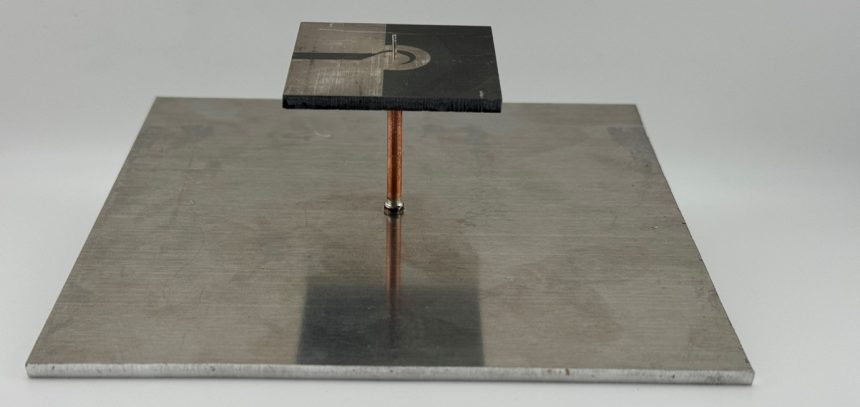
NASA Goddard Printed Electronics Laboratory
The 3D Printing of Electronics Laboratory at NASA Goddard Space Flight Center lists the Voltera NOVA among its printers (line from 100 µm, up to 6 layers, with interchangeable printheads). The team prints circuits and sensors for space missions, including on curved surfaces, which reduces weight, size, and power consumption. Among the laboratory's projects, implemented on various devices, are a printed microheater on the support of the ALICE instrument of the STRIVE mission (approximately 10°C increase at 5,33 W), an S-band antenna tested in a balloon flight, a 28 pF silver-on-Kapton capacitor, and interconnects replacing wire bonds.
Printed S-band telemetry antenna before balloon flight. Photo: NASA.
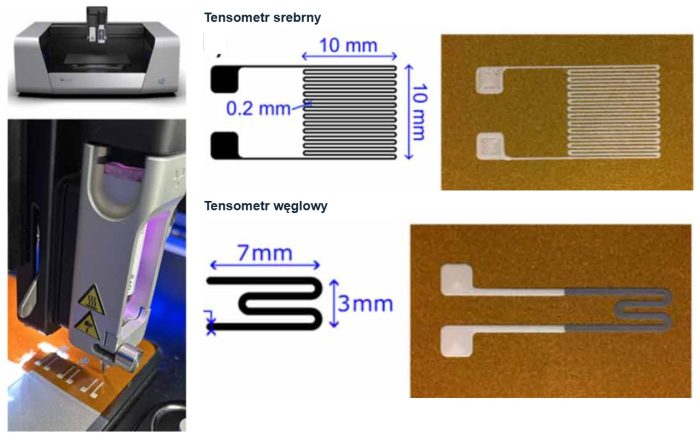
Imperial College London – Strain Gauges for Aerospace Composites
A team from Imperial College London (Department of Aeronautics) printed silver and carbon strain gauges on Kapton substrates using NOVA and compared them with commercial foil strain gauges on CFRP composite plates. The silver strain gauges had a sensitivity factor of approximately 2,75 and good linearity, comparable to commercial strain gauges, making them suitable for quantitative fatigue monitoring. The carbon strain gauges had a resistance of the order of kiloohms (silver around 10 Ω), but a sensitivity of 10–12 in tension and good repeatability over 2000 fatigue cycles.
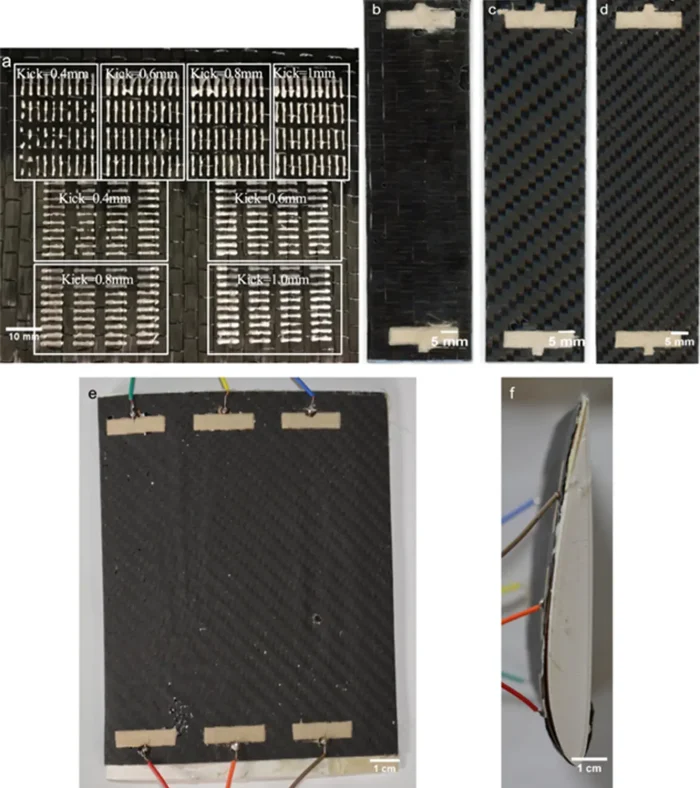
York University – Self-Heating UAV Wings
The Electronics Additive Manufacturing Lab team printed silver electrodes on carbon fiber fabrics (12K UD, 6K, and 3K twill) using the V-One. These, when infused with epoxy resin, created flat, three-dimensional wing-shaped elements. The composite acts like a heater for de-icing drone wings: the team selected repeatable and scalable printing parameters, and the heaters reached temperatures sufficient to melt ice.
Typical uses of Volter in space projects
- PCB prototypes for CubeSats and SmallSats: power supply (EPS), RF communication modules, telemetry and attitude control systems (ADCS).
- Test boards for component validation prior to environmental qualification: thermal cycling, vibration and vacuum.
- Antennas, microheaters and interconnects printed on curved surfaces and flexible substrates (NOVA).
- Technology demonstrators before the project is transferred to space-compliant production (ECSS, NASA).
Voltera is used for prototyping and research. Flight hardware requires qualification in accordance with mission requirements and ECSS or NASA standards.
Electronics prototypes for soldier equipment and defense systems
Voltera describes three areas of NOVA defense applications: soldier personal equipment, defense equipment, and harsh environment electronics. Below are designs printed on NOVA and V-One, along with their parameters.
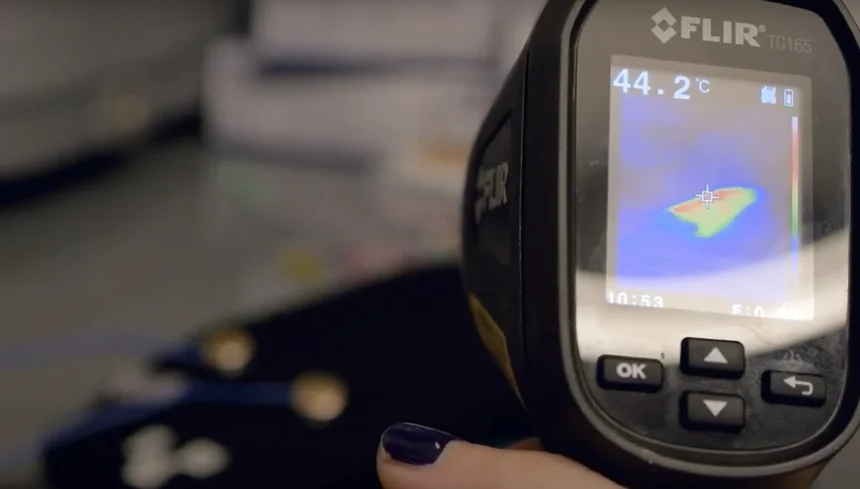
Heating of clothing and gloves
NOVA printed a heater using ACI SH5025 ink on a cotton glove: at 12V, it reaches about 40°C, and higher voltages allow for higher temperatures. In another project, a circuit made of stretchable silver ink on TPU, sewn into a pocket, heated to 45–50°C within a minute of connecting the battery, and the printing itself took less than 15 minutes. Applications: gloves, shoe inserts, and jackets.
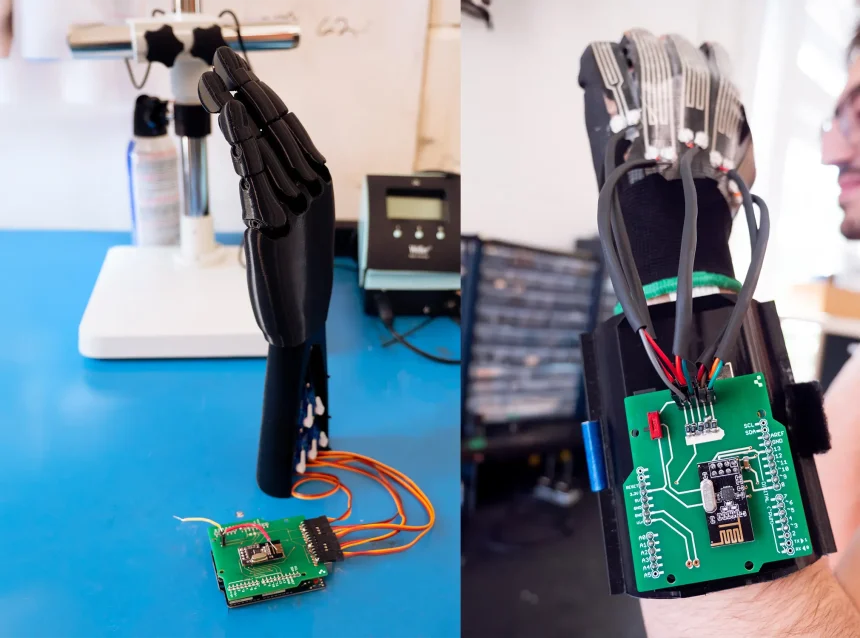
Remote control of robots
A glove with strain gauges printed with stretchable silver ink on TPU wirelessly (2,4 GHz) controls a robotic hand with five servos, with fingers that flex up to 60°. The transmitter and receiver boards are made using V-One. Such interfaces are useful for explosive ordnance neutralization, underwater work, and reconnaissance in hazardous areas.
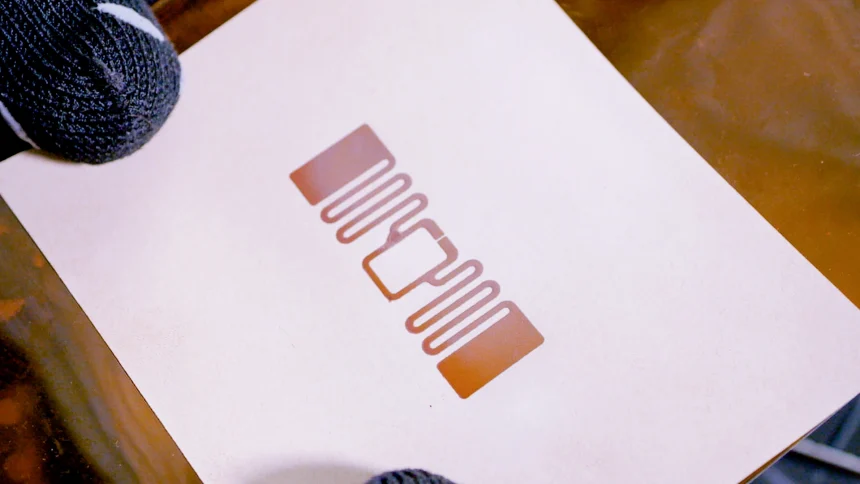
UHF RFID antennas and tags
A 95 x 15 mm UHF RFID antenna was printed with copper-based conductive ink (Copprint LF-301) on paper. Printing took approximately 15 minutes, baking for 15 seconds at 270°C, and the S11 match was -29,4 dB at 922,5 MHz. According to Volter, the tag performed better than off-the-shelf market tags. Applications include equipment identification and tracking, UHF localization, and form-fitting antennas for drones and vehicles.
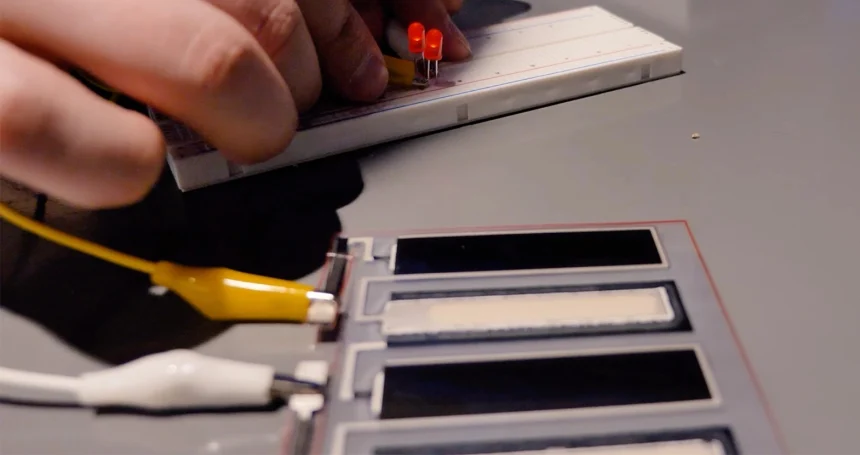
Printed batteries
The seven-layer zinc-manganese battery printed on PET film has eight cells, a voltage of approximately 2,4 V, a capacity of approximately 1 mAh, and dimensions of 90 × 85 × 0,75 mm. Flexible power sources can power wearable electronics, such as GPS trackers or motion sensors, without the need for heavy batteries and wires.
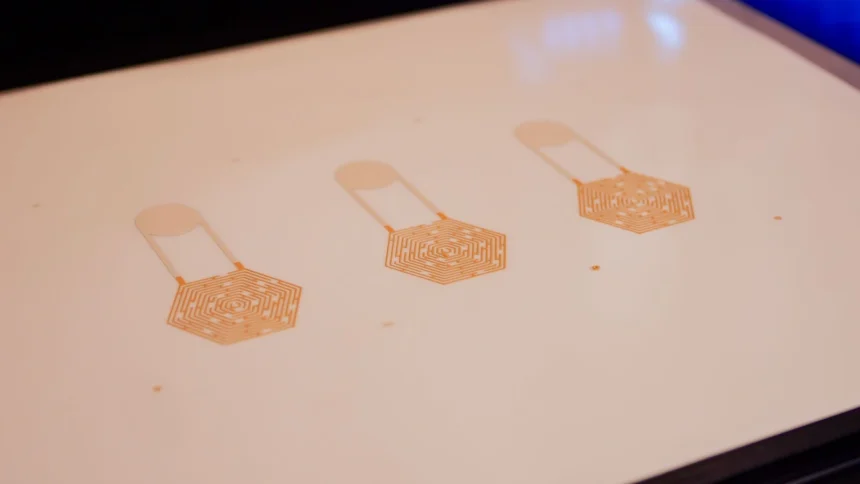
Health monitoring
Dry ECG electrodes made of gold and stretchable silver ink on TPU can be integrated into a shirt or chest strap to monitor heart rate in real time. Details of the project are described on the medical applications page.
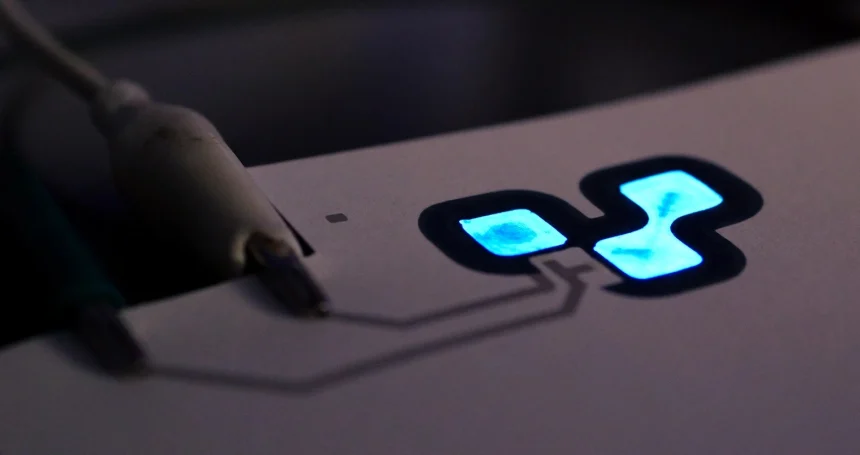
Electroluminescent displays
A four-layer EL display (conductive layer, dielectric, phosphor, and top electrode) printed on paper and PET illuminates when powered by a 140V AC converter. Thin and vibration-resistant, these displays are ideal for control panels and rugged electronics. NOVA also prints optically variable materials that change color under UV light.
Blackleaf Graphene Heating Films and Inks for Drones and Equipment
Blackleaf is a French graphene manufacturer founded in 2018, with 18 patents and a production capacity of 36 tons per year. Graphene is used to create NEOBLACK water-based conductive inks and BLACKHEATER flexible heating foils, which heat evenly across the entire surface, including curved elements such as wing leading edges.
- Thickness 50–300 µm and minimum bend radius 2 mm – the foil fits in tight spaces and adapts to curves.
- Power density from 0,01 to 6 W/cm², temperature up to 200°C, power supply from 3 to 480 V.
- PET, TPU, PEI, PU and textile substrates, silver or copper electrodes.
- Ready-made BLACKHEATER GPAD foils operate in the range of -40 to 120°C.
- CE, RoHS and REACH compliant.
- According to the manufacturer (comparative data): up to 5 times more power than etched heaters, up to 67 times thinner than silicone heaters and up to 1,7 times higher temperature than PTC heaters.
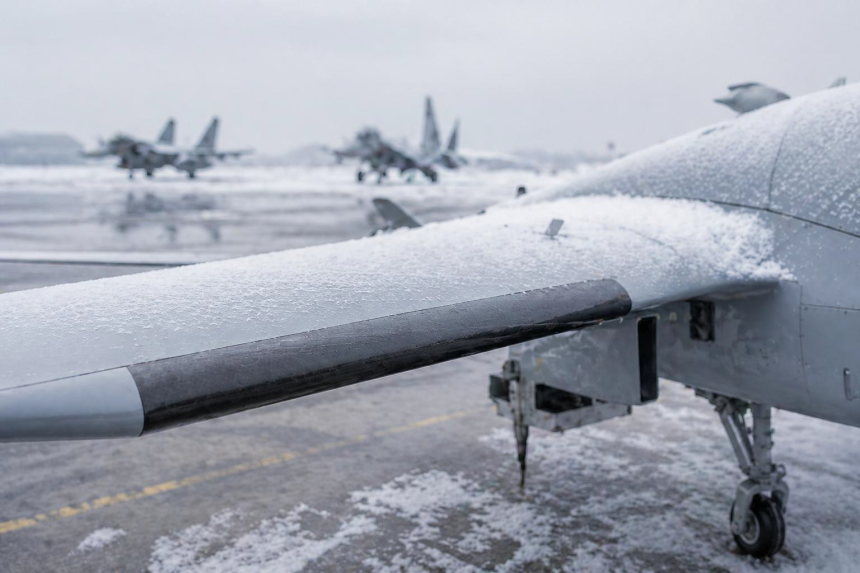
Iced wing of an unmanned aircraft – heating foil protects the leading edge from ice.
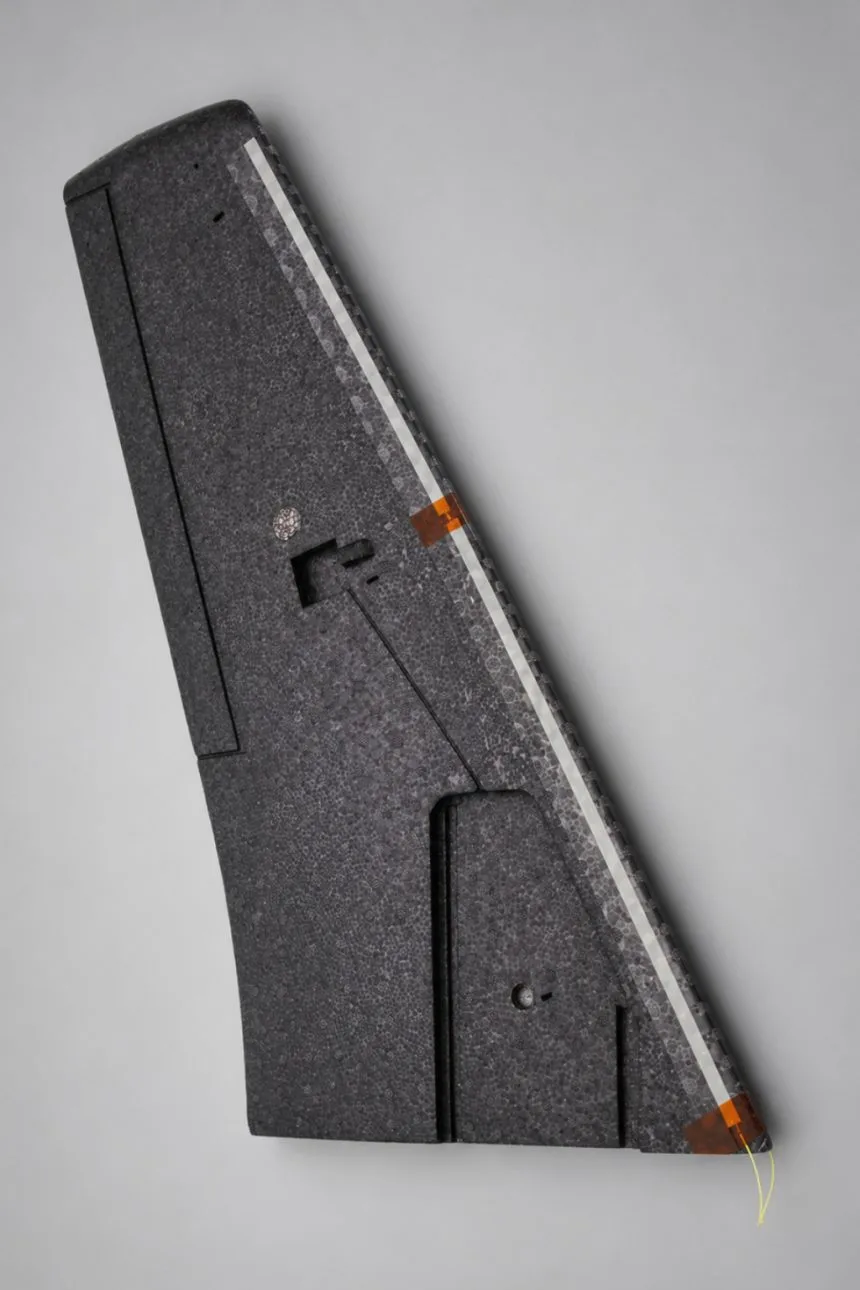
Drone and UAV de-icing
The BLACKHEATER GPAD 20+ is a self-adhesive 500 x 50 mm strip that can be cut to size: 12 V, 20 W (0,8 W/cm²), approx. 95°C at full power. It protects wing edges from icing and batteries and on-board electronics from the cold.
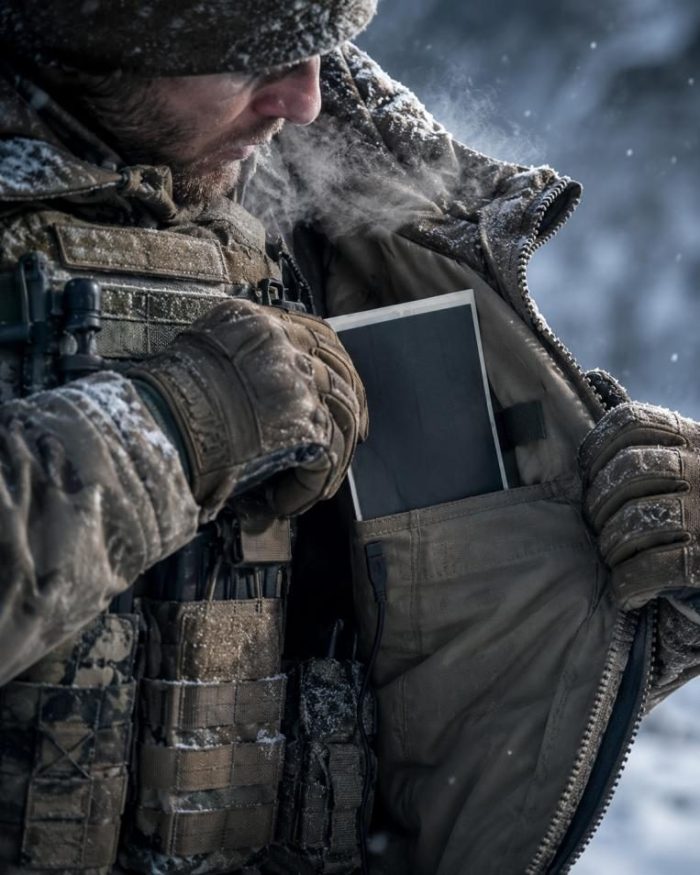
Warming the soldier and equipment
The GPAD 10+ (5V power supply from a power bank via USB-C) and GPAD 11+ (clamp connector) foils are 123,5 x 97 mm and reach approximately 45°C at 8 W. The compact foil fits under your uniform or in your pocket and provides instant warmth in the field – it also protects your electronics from the cold.
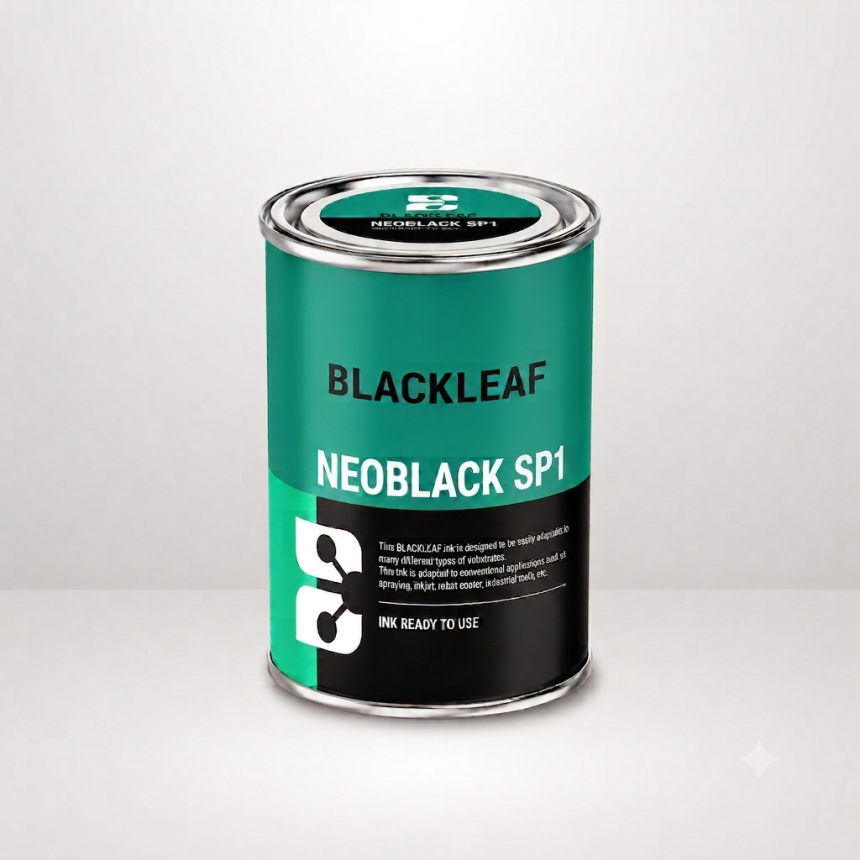
NEOBLACK graphene inks
Water-based graphene screen printing inks without toxic solvents: 3-minute cure at 120°C, adhesion up to 5B (ISO 2409), and a minimum bend radius of 1 mm. According to the manufacturer, the surface resistance of the printed layer starts at 24 Ω/sq/mil. NEOBLACK inks are used to print custom heaters and traces.
Blackleaf anti-icing system test
- 300 × 300 mm film on PET, 48 V, 0,09 W/cm², up to 120°C: surface temperature 98–102°C.
- 600 samples: surface resistance variation within ±5% (4,1% deviation from the mean).
- 7 hours of operation at approx. 100°C without temperature drift (41 V, 0,85 A, 34 W).
- Cycles of 3 minutes of 50W heating and 4 minutes of rest for 6 hours, repeated for a month - no failures.
Blackleaf Military Projects: Heated Clothing, Shields, and Thermal Decoys
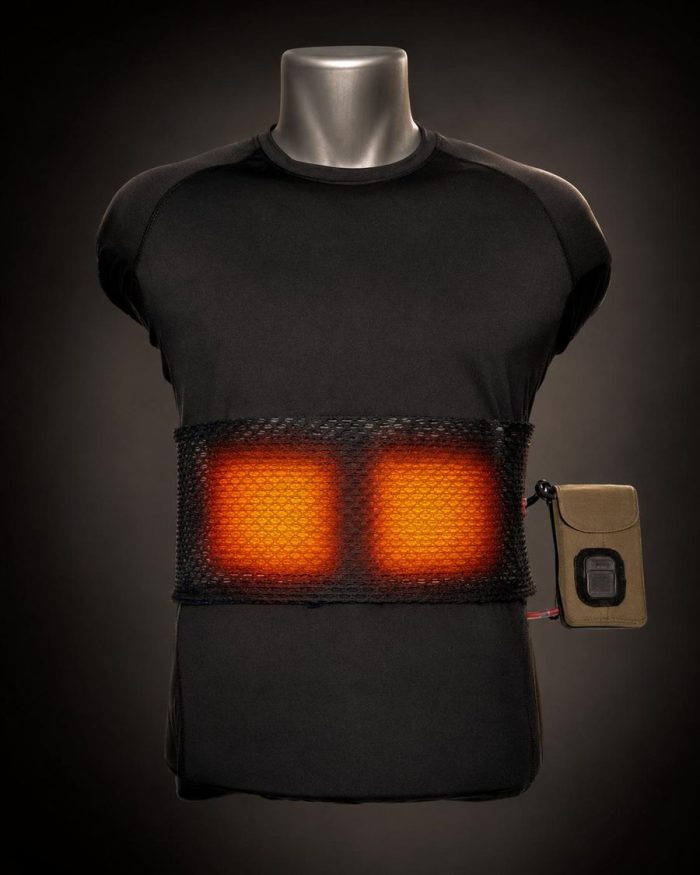
Heated clothing for soldiers
In Army Lab Design #1, Blackleaf integrated heating foils printed directly onto the textiles into the garment. They evenly heat key torso areas and are designed to withstand extreme conditions.
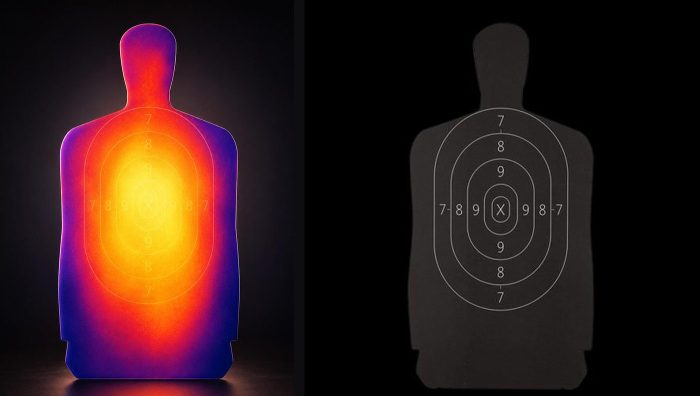
Thermal shields for training
The heating foil on the silhouette target replicates a realistic human heat signature (Army Lab Design #2). These targets are used for training with night vision, thermal sights, and thermal optics – even at night and in low-visibility conditions.
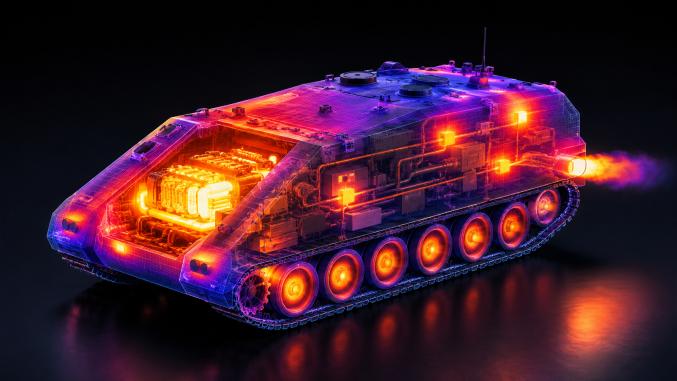
Thermal decoys
Lightweight, flexible heating foils can replicate the heat signatures of vehicles and equipment (Army Lab Design #3). Mock-ups with such foils simulate targets for infrared surveillance and guidance systems, distracting them from the actual equipment.
Foils are available as pre-engineered models or custom-designed, from specification—voltage, power, temperature, dimensions, and substrate—through prototype and pilot production, all the way to industrial production. Special projects, such as thermal shields and decoys, are discussed upon request.
EMI shielding and radio wave absorption
Conductive graphene coatings reflect and attenuate electromagnetic radiation. This is used in electromagnetic shielding (EMI/EMC) and radio frequency absorbing materials – particularly where a metal casing, mesh, or metallization is impractical.
Without metal or plating
A water-based graphene coating applied by spraying creates a continuous conductive layer on plastics, composites, textiles and glass – without a metal mesh or metallization.
Effectiveness tailored to the project
Shielding effectiveness is primarily determined by the surface resistance of the layer: the lower the resistance, the greater the attenuation. This resistance is regulated by the thickness of the applied layer and the choice of material.
Type of use
Electronics housings and covers made of plastics and composites, panels, technical fabrics and components that must meet electromagnetic compatibility (EMC) requirements.
V-One, NOVA or Blackleaf – what to choose?
Voltera V-One – PCBs and control electronics
- Printing tracks with silver conductive ink on FR1 (track and gap from 200 µm), drilling, solder paste and reflow in one device.
- Test, control and receiving boards – e.g. for a robot control glove.
- PCB prototypes for CubeSats and technology demonstrators.
Voltera NOVA – antennas, sensors and heaters
- Printing on flexible, stretchable and textile substrates: TPU, PET, Kapton, Kevlar®, cotton.
- Inks and pastes with a viscosity of 1,000 to 1,000,000 cP (according to the manufacturer's data; the range depends on the material rheology, nozzle diameter and dosing parameters), multi-layer printing.
- Print area 220 × 300 mm – antennas, strain gauges, batteries, EL displays.
Blackleaf – graphene foils and inks
- Ready-made BLACKHEATER GPAD heating foils or foils designed to measure.
- NEOBLACK water-based graphene inks for screen printing your own heaters.
- The path from prototype, through pilot series, to industrial production.
What can be prototyped
We select the specific configuration of the device, materials and substrates for your project.
See Volterra in aviation and defense projects

Voltera at Princeton – electronics for aviation and space
Mechanical and Aerospace Engineering students building satellites. Video in English.
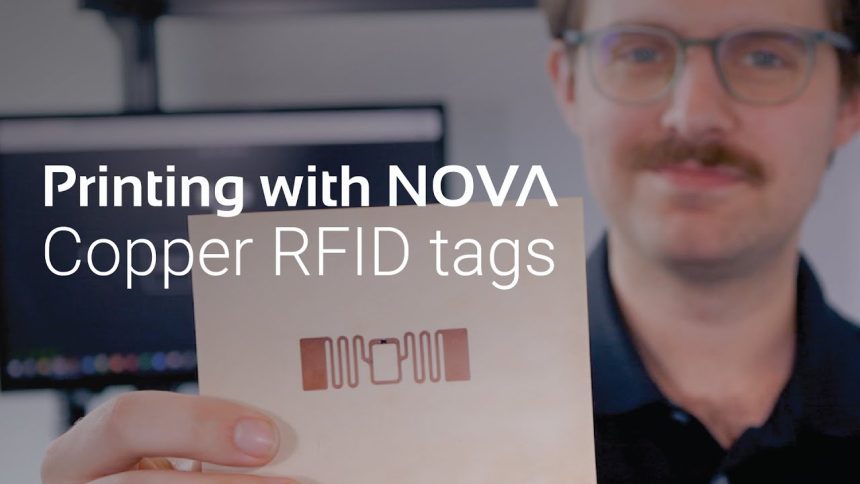
Copper ink RFID antenna printing on NOVA
Printing a UHF antenna, sintering, and assembling the RFID chip. Video in English.
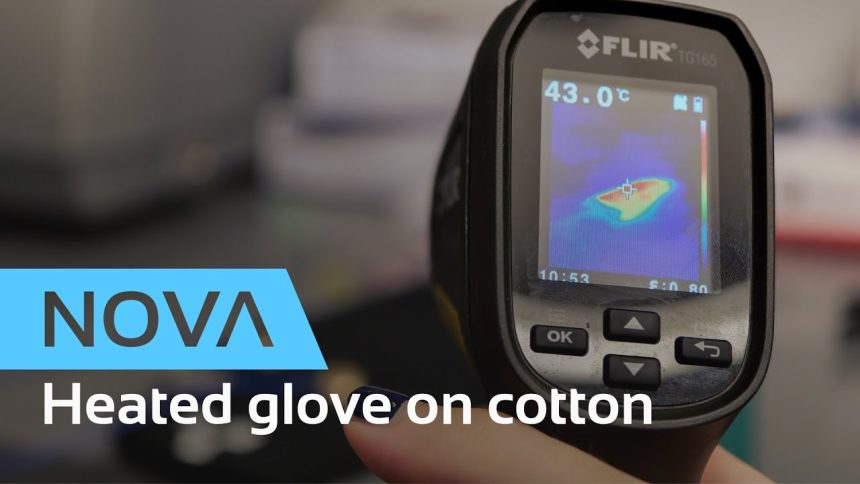
Heated glove printed on cotton
Printing a heater on fabric and measuring it with a thermal imaging camera. Video in English.
NOVA: rigid, flexible and stretchable electronics
An overview of printing options on various substrates. Video in English.
What does cooperation with Chemikonics look like?
1. Describe the application
Describe what you want to prototype or protect from the cold: boards, antennas, sensors, heaters, or foils. Provide the substrate, dimensions, power supply, and operating conditions – no finished design required.
2. We choose a solution
We advise you whether V-One, NOVA, ready-made Blackleaf foil or custom-made foil will be better, and what inks, pastes and substrates will be needed.
3. We prepare an offer
You receive a personalized offer tailored to your application, schedule, and budget.
Most frequently asked questions
Are Voltera printers suitable for space projects?
Yes, at the research and prototyping stage. Princeton University students are prototyping CubeSat boards on the V-One, and NASA Goddard's Printed Electronics Laboratory is equipped with the Voltera NOVA. However, flight hardware requires qualification according to mission requirements and ECSS or NASA standards.
What defense applications can be prototyped on Voltera NOVA?
These include heaters in clothing and gloves, strain gauges for robot control, UHF RFID antennas and tags, thin PET batteries, health monitoring electrodes, and electroluminescent displays. Control and receiver boards are manufactured on the V-One.
What substrates does Voltera NOVA print on?
On cotton, nylon, aramid fabrics like Kevlar®, TPU, PET, polyimide (Kapton), paper, glass, and ceramics. V-One prints on rigid laminates like FR1.
What are Blackleaf BLACKHEATER heating foils?
These thin (50–300 µm) and flexible heating foils made of Blackleaf graphene ink. They heat evenly across the entire surface and reach up to 200°C, while the finished GPAD models operate in a temperature range of -40 to 120°C. They are used for de-icing drone wings, heating batteries, electronics, and clothing, among other things.
Can Blackleaf heating foil be custom designed?
Yes. Blackleaf designs films based on the specified voltage (3–480 V), power (0,01–6 W/cm²), temperature, dimensions, and substrate (PET, TPU, PEI, PU, textiles). The process leads from prototype, through pilot series, to industrial production.
Do you offer EMI shielding and RF absorption materials?
Graphene conductive materials can reflect and absorb electromagnetic waves, which is used in EMI shielding and radio frequency absorbing materials. These solutions are individually tailored, so details are available upon request.
Does Chemikonics provide solutions to defense sector entities?
Yes. Chemikonics is an authorized distributor of Voltera and Blackleaf in Poland and also accepts inquiries from defense sector entities. We accept inquiries via the form on this page or by emailing sales@chemikonics.com.
Publications and research materials
- Philibert M., Mr. Y., Aliabadi FMH, Sharif Khodaei Z., Direct ink writing of flexible strain gauges for IoT-enabled structural health and usage monitoring of aerospace composites, Smart Materials and Structures 35(9) (2026) 095011. DOI →
- Idris MK et al., Printing electronics directly onto carbon fiber composites: unmanned aerial vehicle (UAV) wings with integrated heater for de-icing,Engineering Research Express 2(2) (2020) 025022. DOI →
- Ba H. et al., Lightweight, few-layer graphene composites with improved electro-thermal properties as efficient heating devices for de-icing applications, Carbon 182 (2021) 655–668. The first author is affiliated with BlackLeaf SAS. DOI →
- NASA Goddard Space Flight Center, 3D Printing of Electronics Laboratory. nasa.gov →
Related pages
Voltera V-One – PCB printer
Trace printing, drilling, solder paste and reflow in one device.
Voltera NOVA – flexible electronics printing
Material dosing system for antennas, sensors and heaters.
Graphene inks and materials
BLACKHEATER heating foils and NEOBLACK inks from Blackleaf.
Prototype electronics for defense and space in your own lab.
Describe your application and we will prepare a personalized offer for Voltera V-One, NOVA or Blackleaf graphene solutions.
Do you have any questions? Check Chemikonics Product FAQs.
Ask for an offer
Defense and space