
Electronics printing for medicine and bioelectronics
Voltera NOVA and V-One allow research teams to prototype biomedical electrodes, wearable sensors, and flexible bioelectronic systems in situ—on TPU, PET, or fabric, without screens or masks. We also select VFP conductive inks for sensors and wearable electronics.
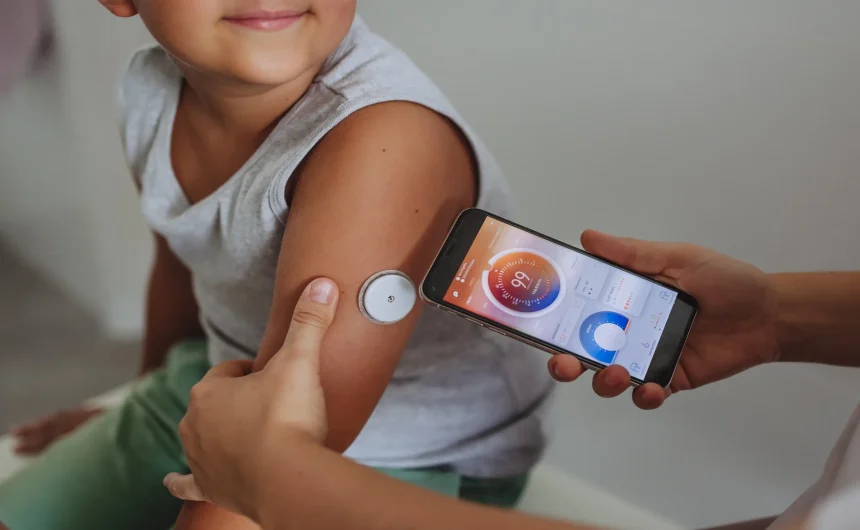
Wearable sensors with smartphone readings are one of the main directions of bioelectronics.
Bioelectronics prototyping without outsourcing
Bioelectronics bridges electronics with biology: sensors, electrodes, and systems that monitor or interact with biological processes—from ECG electrodes and wearable sensors to research into tissue-interacting systems. Prototypes typically require soft or stretchable substrates such as TPU, PET, PDMS, or fabrics, as well as conductive inks based on silver, gold, carbon, or conductive polymers. Voltera applies these materials directly to the substrate based on a design file, so changes to the electrode pattern can be verified the same day.
Electrodes and sensors on the skin
ECG electrodes, tattoo electrodes for measuring EMG signals, and wearable sensors printed on thin, flexible substrates that adapt to body movement.
Soft and flexible substrates
NOVA prints on TPU, PET, polyimide, and fabrics, and its camera and multi-layer printing make it easy to apply subsequent layers, such as conductive polymer on gold electrodes.
A wide range of materials
Silver, copper, carbon, and gold-based inks and pastes, dielectrics, and conductive polymers such as PEDOT:PSS. NOVA dispenses materials with viscosities ranging from 1,000 to 1,000,000 cP (according to the manufacturer's specifications); in practice, the selection of nozzle, temperature, and dispensing parameters depends on the material's rheology.
Rapid iteration
The team at Polytechnique Montréal can produce a prototype in a single day, instead of sequentially creating screens for each design version. Changing the design simply requires a new file.
Bioelectronics printed on Voltera – examples from universities and laboratories
Below are four projects from research teams that used Voltera NOVA and V-One to prototype electrodes and sensors. These are laboratory studies and prototypes—not medical devices.
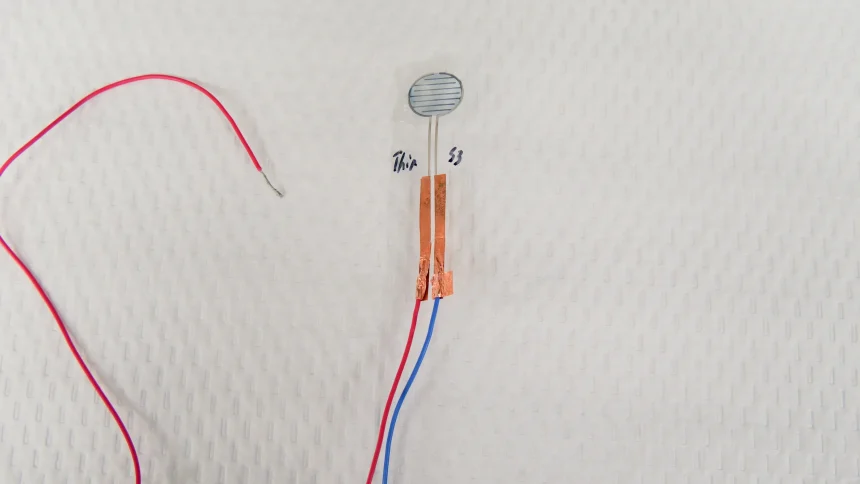
Polytechnique Montréal – Stretchable Bioelectronics
Prof. Fabio Cicoira's team is investigating the conductive polymer PEDOT:PSS in ECG electrodes, pressure sensors, and organic electrochemical transistors (OECTs). The work, conducted on the V-One, acquired in 2020, has been complemented by the NOVA, which more precisely dispenses materials onto flexible TPU substrates. The pressure sensor is made of a layer of silver ink on TPU coated with a second layer of conductive polymer, and the NOVA camera facilitates layer alignment.
Polytechnique Montréal – Voltage Limits for PEDOT:PSS Electrodes
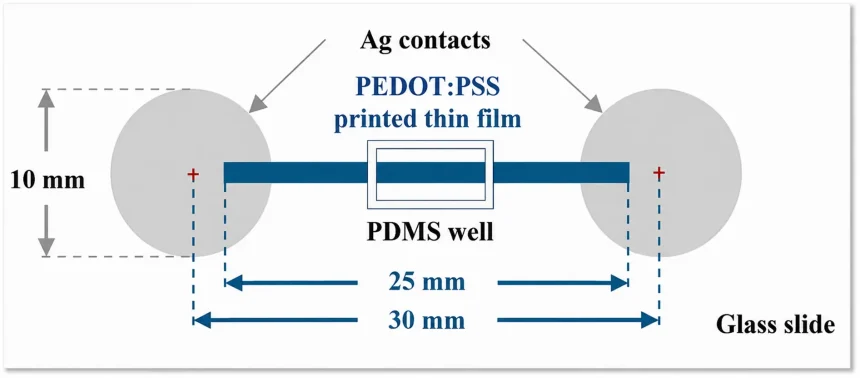
In a paper published in Nano Futures in 2026, the team printed thin PEDOT:PSS layers (average 2,39 µm) on NOVA between silver contacts and tested the voltages they withstood in dry air, in a salt solution simulating body fluids, and in an ionic liquid. In air, the layers were stable up to about 40 V, but in salt solution, the damage threshold dropped to about 1,2 V. Pulses shorter than 10 ms degraded the material much less than continuous voltage.
Electrode scheme: PEDOT:PSS layer between two silver contacts (Dongnang et al., CC BY 4.0).
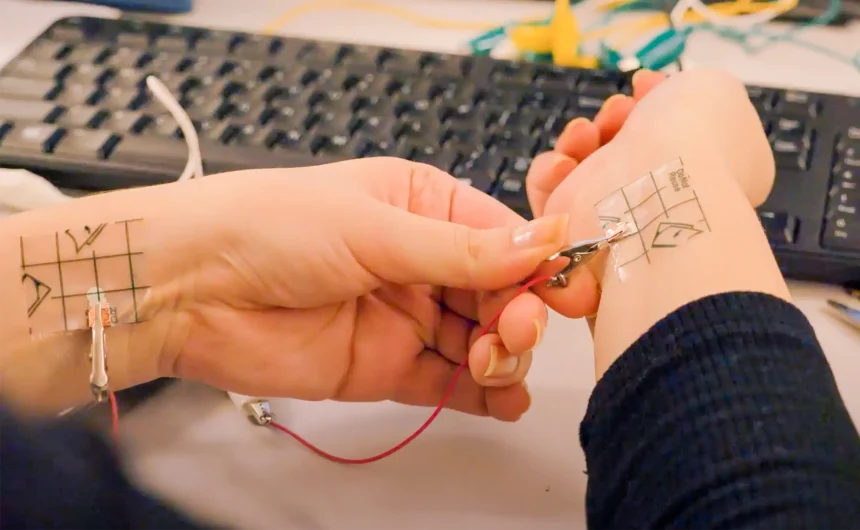
York University – Silver Tattoo Electrodes
Yoland El-Hajj's team at York University printed silver tattoo electrodes for monitoring biosignals such as EMG on tattoo paper and compared two methods: extrusion on NOVA and inkjet printing. The extrusion-printed electrodes had a significantly lower surface resistance (9,4 mΩ/sq vs. 25,1 kΩ/sq), and the ink did not penetrate the paper. The inkjet electrodes were more flexural in high-traffic areas. This led to the formation of Epictrode Health, a company developing biomedical printed electronics.
University of Southern California – Intestinal Gas Mapping Sensor
A team from the University of Southern California has developed a system in which a swallowable capsule works with a wearable sensor, and together they map intestinal gas concentrations using artificial intelligence. The wearable sensor was developed using Voltera NOVA. The work was published in Cell Reports Physical Science in 2024.
What can be prototyped for Volterra?
These are examples of applications described in research papers. We select the specific device, ink, and substrate configuration for your project.
Gold Conductive Ink ECG Electrodes on TPU
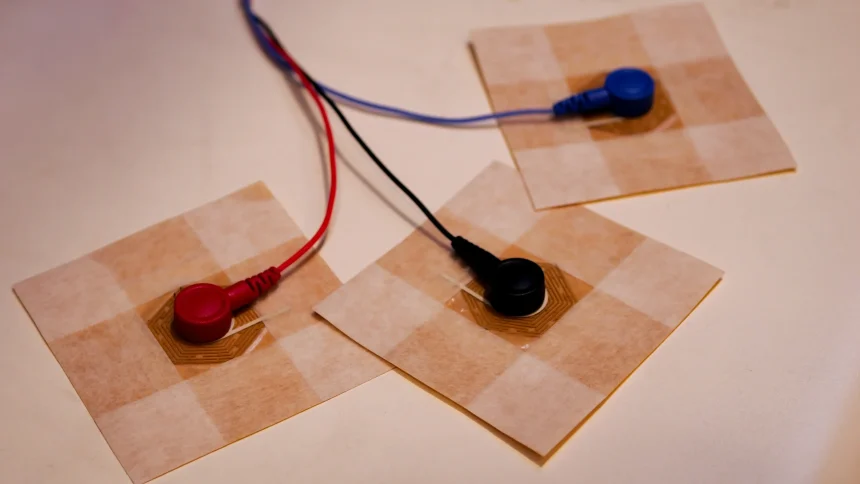
Voltera has built a demonstration set of dry ECG electrodes that combines NOVA and V-One. The electrodes feature a hexagonal maze pattern inspired by dry electrode research, eliminating the need for gel, which can irritate the skin.
- Base layer: stretchable silver paste (Celanese Micromax Intexar PE874) on TPU, dispensed with a 150 µm nozzle and cured for 15 minutes at 130°C.
- Contact layer: gold conductive ink (Creative Materials EXP 2613-40), described by Volter as biocompatible, 200 µm nozzle, cured for 10 minutes at 135°C.
- Final processing: holes for latches and lamination of PET strips between TPU layers to prevent the electrode from stretching excessively.
- Measurement module: control board with AD8232 and Arduino Micro; traces printed with silver ink on V-One on FR1 substrate, 3D printed housing.
- Result: The electrodes were flexible enough to operate on a moving body and record heart rate and ECG. The description does not provide quantitative measurements.
The gold ink proved the most challenging: particles would settle and clog the nozzle. Mixing the ink in a centrifugal mixer before printing solved the problem. The system was first tested with a cheaper silver ink. This project is for demonstration purposes only and is not intended to diagnose or treat disease.
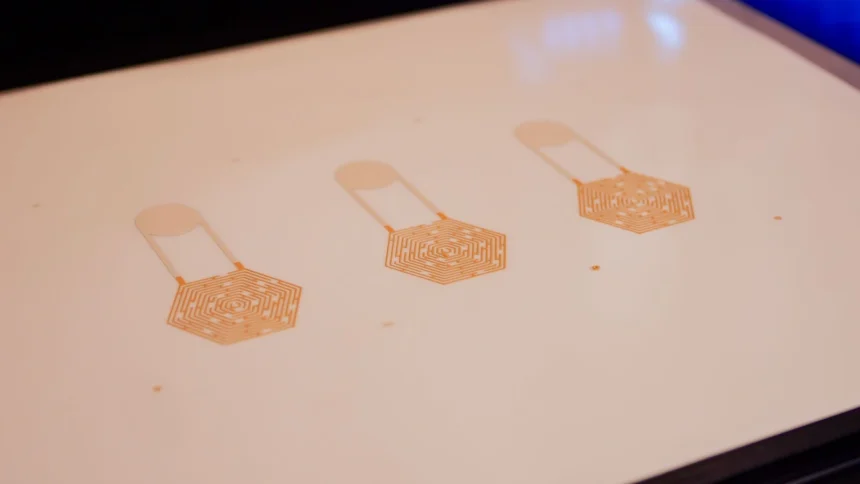
Three ECG electrodes printed on NOVA.
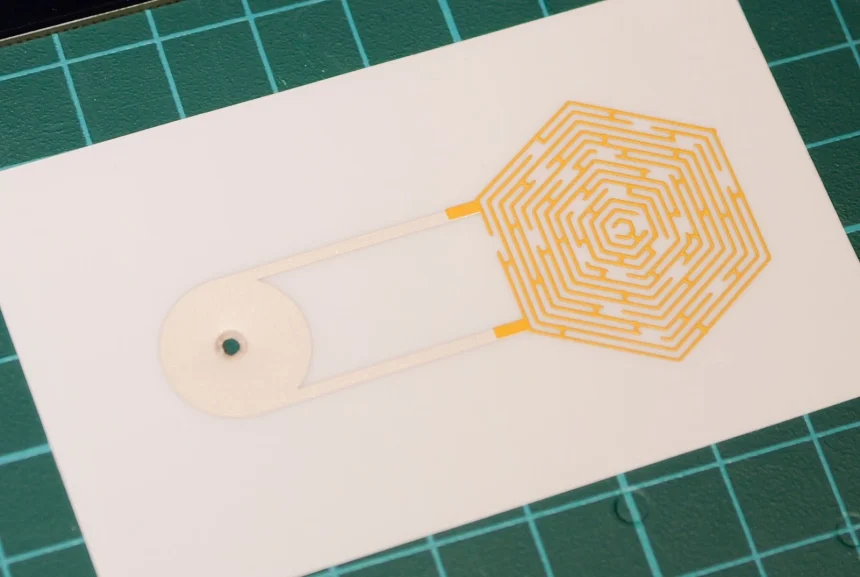
Electrode with a hole for a latch.
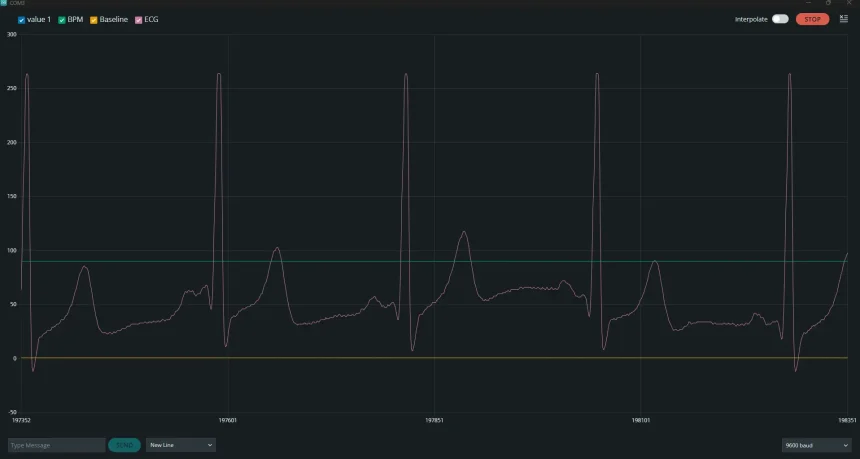
ECG waveform recorded with printed electrodes.
Stretchable TPU and fabric circuits
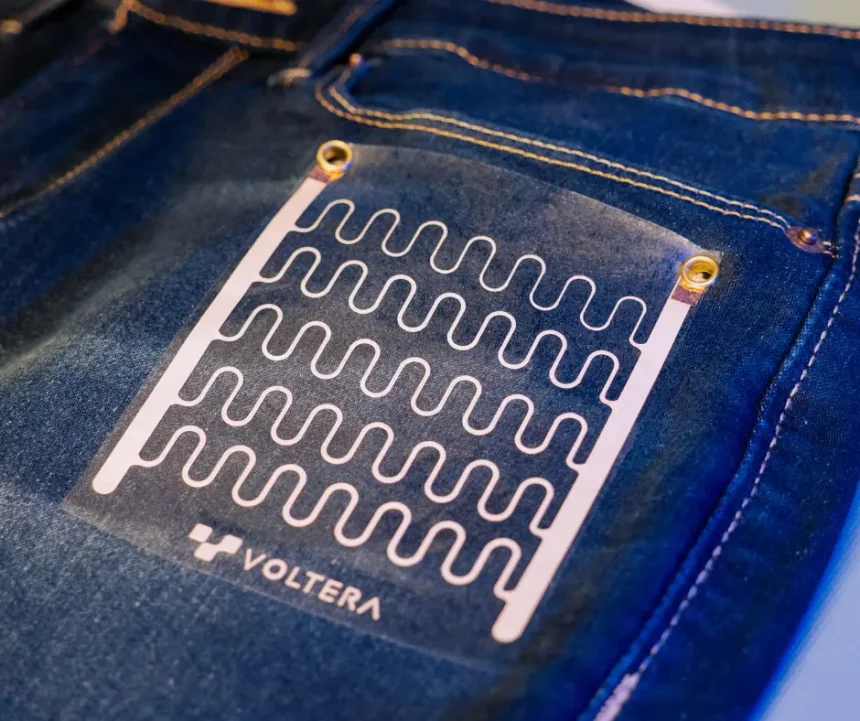
Stretchable silver ink circuit on TPU, laminated to fabric.
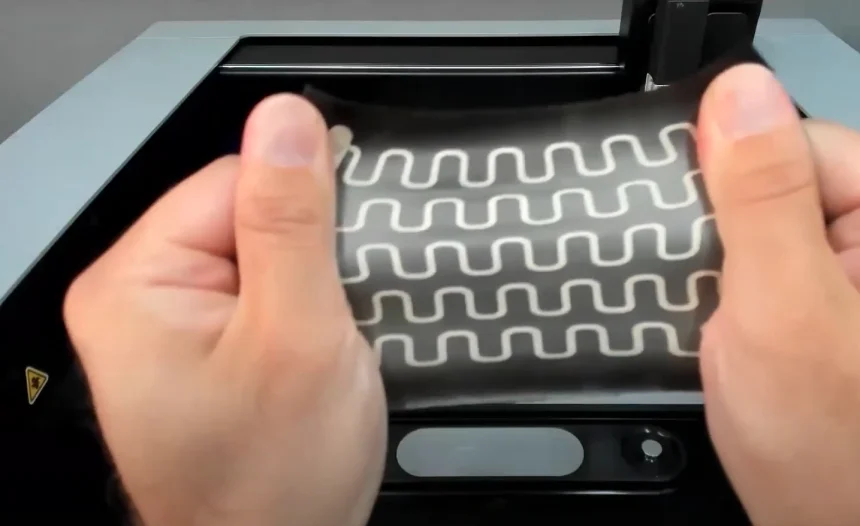
The meandering pattern of the tracks maintains conductivity when stretched.
During the webinar, Voltera NOVA printed a stretchable circuit using Celanese Intexar PE874 silver conductive ink on a TPU film (TE-11C). The print took about five minutes, and after laminating it to fabric, the circuit retained good stretchability.
- The path width, print height and nozzle temperature are set in the software.
- The substrate is mounted on a vacuum table, and the mounting method depends on whether it is flexible or rigid.
- The built-in camera and lighting allow you to check the result, and selective printing allows you to repeat only imperfect elements instead of the entire design.
- Flexible circuits are connected to rigid readout boards made on the V-One.
VFP Conductive Inks for Sensors and Wearable Electronics
In addition to Voltera printers, we offer conductive inks from VFP Ink Technologies, a manufacturer of screen printing and flexographic inks. VFP inks designed for printed electronics can be used with the Voltera V-One and NOVA. They are suitable for sensors, flexible systems, and wearable electronics, and when transitioning from laboratory prototyping to mass production, screen printing or flexographic inks can be selected.
Silver Electron Stretchable
Solvent-based silver-based conductive ink for wearable electronics, smart textiles, and thermoformed components (IME/IMD). Substrates: PET, polycarbonate, and polyurethane. Non-CMR formulation.
Silver Electron and Thin Film
Silver-based conductive inks for traces, sensors, and flexible circuits. Thin Film is used for thin, uniform layers with good resolution. Substrates: PET, PVC, polycarbonate, glass, polyimide, and paper.
Carbon Electron 001 and 003
Solvent-based carbon resistive inks for sensor electrodes, carbon traces, and printed resistors. CEL001 is compatible with PET and paper substrates.
NOVA dispenses materials with viscosities ranging from 1,000 to 1,000,000 cP (according to the manufacturer's specifications), including screen printing inks. In practice, the selection of nozzle, temperature, and dispensing parameters depends on the material's rheology. We verify the compatibility of a specific VFP ink with the process and substrate before purchase. All conductive inks →
NOVA or V-One – what to choose for bioelectronics?
Voltera NOVA – electrodes and sensors
- Printing on TPU, PET, polyimide, glass, ceramics and fabrics.
- Inks and pastes with a viscosity of 1 to 000 cP (according to the manufacturer's data), including silver, gold, carbon and conductive polymers.
- Multi-layer printing with a camera for layer positioning; print area 220 × 300 mm.
Voltera V-One – reading and control modules
- Boards on rigid substrates, e.g. FR1, with silver conductive ink – this is how the control module in the EKG project was created.
- Solder paste dispensing, hole drilling and reflow in one device.
- Minimum track width and spacing 200 µm (metal nozzles).
Many projects use both devices: NOVA for electrodes and sensors, V-One for readout electronics.
See how electrodes and sensors are printed
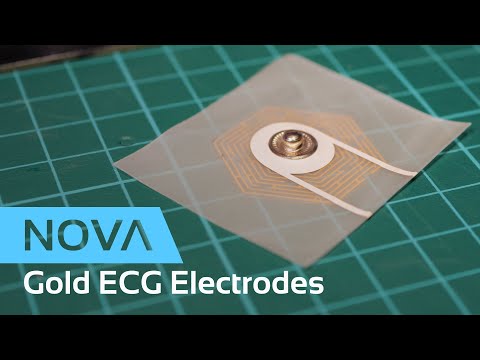
Gold-ink EKG electrode printing on Voltera NOVA
From the adapter board, through printing the silver and gold layers, to assembly and testing of the electrodes on the skin. The video is in English.
Stretchable bioelectronics printed on V-One and NOVA
Work by a team from Polytechnique Montréal. Video in English.
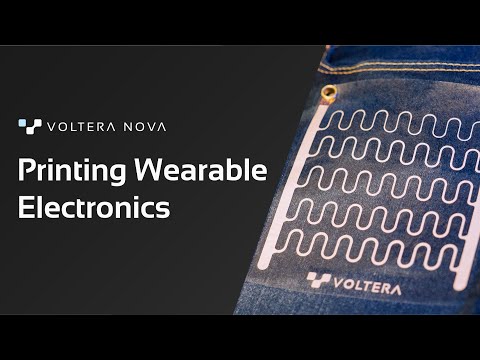
Webinar: Wearable Electronics Printing at NOVA
Calibration, printing a stretchable circuit on TPU, and laminating it to fabric. Video in English.
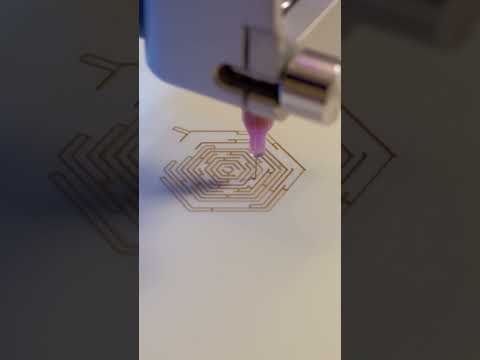
How to Print an EKG Electrode with Gold Ink
A short video demonstrating ECG electrode printing. The video is in English.
What does cooperation with Chemikonics look like?
1. Describe the application
Please describe what electrodes, sensors, or systems you'd like to prototype, on what substrate, and from what materials. A brief description will suffice – you don't need a finished design.
2. We select the device and materials
We advise whether NOVA, V-One, or both devices will be better, and what conductive inks, pastes, and substrates – also from the VFP range – will be needed.
3. We prepare an offer
You receive a personalized offer tailored to your application and budget.
Frequently asked questions about electronics printing for bioelectronics
Are Voltera printers suitable for prototyping biomedical electrodes?
Yes, in research labs. NOVA has printed, among other things, ECG electrodes using gold ink on TPU, silver tattoo electrodes, and PEDOT:PSS layers, while V-One is producing readout and control boards. These are research prototypes: a medical device requires a separate design, testing, and certification process.
On what substrates can electronics for bioelectronics be printed?
NOVA prints on TPU, PET, polyimide, glass, ceramics, and fabrics. In the described studies, electrodes were also printed on tattoo paper (NOVA) and PDMS (V-One). V-One performs well on rigid substrates, such as FR1.
What conductive materials can be used?
Silver, copper, carbon, and gold-based inks and pastes, dielectrics, and conductive polymers such as PEDOT:PSS. NOVA dispenses materials with viscosities ranging from 1,000 to 1,000,000 cP (according to the manufacturer's specifications), including screen printing inks. In practice, the choice of nozzle, temperature, and dispensing parameters depends on the material's rheology. We verify the compatibility of a specific ink, including those from the VFP range, before purchasing.
Are VFP inks biocompatible?
VFP designs Silver Electron and Carbon Electron inks for printed electronics and does not claim biocompatibility or medical applications in its product data sheets. If the component is intended to come into contact with skin or body fluids, we will work with you to verify available data with the manufacturer, and material compatibility must be confirmed through appropriate testing.
Will NOVA print ECG electrodes?
Voltera showed a demonstration setup of three dry ECG electrodes: a silver base layer and a gold contact layer on TPU, with a measurement module based on the AD8232 chip. The electrodes recorded heart rate and ECG waveforms from a moving body, but the description does not provide quantitative measurements, and the project is not intended to diagnose or treat disease.
Can the prototype be transferred to serial production?
Yes. Once your design is approved, you can move to screen printing or flexography, selecting VFP conductive inks and substrates.
How to ask for an offer?
Describe your application, substrate, and materials in the form on this page or contact sales@chemikonics.com. We will respond with device and material selection and a personalized offer.
Scientific publications
- Dongnang K. et al., Towards standardized high-voltage testing of printed conducting polymer electrodes: influence of electrolyte environment and pulse duration, Nano Futures 10 (2026) 035002. DOI →
- Stobo A.-M. et al., Closing the Loop: Sustainable and Cost-Effective Glucose Biosensors Through a Circular and Digital Design, Electronics 15(4) (2026) 796. DOI →
- Angsagan A. et al., 3D gas mapping in the gut with AI-enabled ingestible and wearable electronics, Cell Reports Physical Science 5(7) (2024). DOI →
- Kateb P. et al., Printable, adhesive, and self-healing dry epidermal electrodes based on PEDOT:PSS and polyurethane diol, Flexible and Printed Electronics 8 (2023) 045006. DOI →
- El-Hajj Y. et al., Inkjet and Extrusion Printed Silver Biomedical Tattoo Electrodes, IEEE FLEPS 2022. IEEE Xplore →
- Hagler J. et al., Flexible and stretchable printed conducting polymer devices for electrodermal activity measurements, Flexible and Printed Electronics 7(1) (2022) 014008. DOI →
- Lerond M. et al., Combining Electrospinning and Electrode Printing for the Fabrication of Stretchable Organic Electrochemical Transistors, Frontiers in Physics 9 (2021) 708914. DOI →
Related pages
Voltera NOVA – flexible electronics printing
Material dosing system for electrodes, sensors and flexible systems.
Voltera V-One – PCB printer
Trace printing, drilling, solder paste and reflow in one device.
Prototype electrodes and sensors in your own lab
Describe your application and we will prepare a personalized offer for Voltera NOVA, V-One or VFP conductive inks.
Have questions? Check out the Chemikonics product FAQs.
Ask for an offer
Medicine and bioelectronics