


Drones are a demanding environment for electronics: every gram counts, systems operate under vibration and in freezing temperatures, and designs evolve rapidly. In this article, we present two solutions that help in this race. The first is BLACKHEATER, thin graphene heating foils that protect batteries from cold and surfaces from icing. The second is the Voltera V-One and NOVA printers, which shorten the path from idea to working board prototype. Finally, we briefly mention that similar technologies are also of interest to the aerospace and defense sectors.
Why are drone electronics so demanding?
Drone designers struggle with weight, space, and power simultaneously. Each additional component shortens flight time, and each new feature (camera, sensor, connectivity) means a new circuit board or a modification to an existing one. From a materials and tooling perspective, we see two areas where the greatest gains can be made: thermal management at low temperatures and the time needed to build and validate a prototype.
Cold and Ice: The Problem That's Not in the Specs
Lithium-ion batteries deliver less energy at low temperatures and are less able to handle high current loads. This is a well-known phenomenon, which is why battery manufacturers specify acceptable operating temperature ranges. Icing is a separate issue: ice on propellers, wings, probes, and sensors changes mass and flow and can obscure optics.
The solution to this problem must be lightweight, thin, and form-fitting. Traditional heating cables and mats are typically heavier and stiffer, which is why there is growing interest in flexible foil heating elements.
BLACKHEATER: graphene heating foils from BlackLeaf
BLACKHEATER graphene heating foils are manufactured by the French company BlackLeaf, and Chemikonics is the official distributor of Blackleaf graphene materials in Poland. According to the manufacturer's data available on our website, the foils have the following general characteristics:
- work to 200°C,
- power density from 0,01 to 6 W/cm²,
- maximum bending radius Traces,
- carrier material: PET.
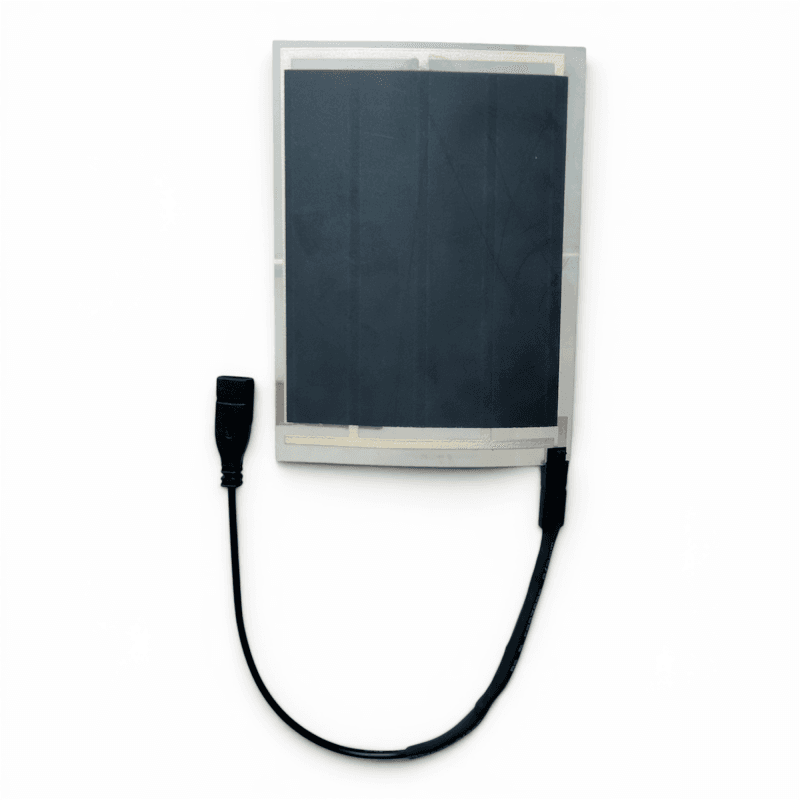
The finished GPAD series components vary in size, voltage, and power. The table below summarizes the entire range:
| Door Design | Dimensions | Power | Nominal power | Mass | Thickness | Temp. surroundings |
|---|---|---|---|---|---|---|
| GPAD 10+ | 150 × 100 mm | 5 V DC | 8 W | 16 gr | 400 um | −40…+120°C |
| GPAD 11+ | 150 × 100 mm | 5 V DC | 8 W | 16 gr | 400 um | −40…+120°C |
| GPAD 20+ | 500 × 50 mm | 12 V DC | 20 W | 15 gr | 295 um | −40…+120°C |
| GPAD 30+ | 100 × 100 mm | 12 V DC | 4 W | 2,13 gr | 185 um | −40…+100°C |
| GPAD 40+ | 330 × 330 mm | 48 V DC | 77 W | 78 gr | 370 um | −40…+100°C |
Source: Chemikonics product page. Surface temperature at nominal power: approx. 58°C (8 W), approx. 95°C (20 W), approx. 60°C (4 W and 77 W).
The lightest member of the range, the GPAD 30+, weighs 2,13g. The GPAD 10+ and 11+ are designed for mobile use and can be powered by a power bank, for example (the GPAD 10+ has a USB-C connector). The GPAD 20+ is a strip that can be cut and glued, while the GPAD 40+ is a larger heating element.
How heating foils can work in drones
On the BLACKHEATER website, we list two applications for drones and UAVs: battery protection from cold and anti-icing . In aviation, the manufacturer also lists applications such as leading edges, probes, nacelles, and engines. The thin film can be adhered to the battery housing or to any surface that needs to be kept free of ice.
Two practical considerations: First, heating power must be factored into the drone's energy budget: the GPAD 10+ has a nominal power of 8 W, and in a small design, this is a value worth considering. Second, we do not publish de-icing test results for specific designs, as they depend on power, component layout, insulation, and ambient conditions. For custom designs, components are selected based on design. The Lab Design Service is available for this purpose : from design, through prototype and pilot batch, to industrial production. Customized paint formulations are also available (BLACKSTREAM).
Custom heaters and sensors: NEOBLACK graphene paints
If the pre-made foil doesn't fit the geometry of your design, you can print your own element. NEOBLACK inks are water-based, conductive graphene inks, available in screen printing (SP1, SP2) and spray printing (SC1B, SC2B, SC3B) versions. According to the manufacturer:
- suitable for substrates such as paper, PET, polyimide (Kapton), TPU, PEI and textiles,
- thermally cure at 120–150°C for 3–5 minutes,
- achieve adhesion up to 5B (ISO 2409) and a bending radius of up to 1 mm,
- NEOBLACK SP1 after two layers (35 µm) it has a resistivity of 20 Ω/sq and maintains resistive stability up to 150°C.
The manufacturer also lists EMI shielding among the applications for graphene conductive paints. However, not every variant has every confirmed function, so details should be checked in the specific paint's technical data sheets.
Drone electronics are changing fast: prototype in hours, not weeks
Each new version of a drone requires new sensors, controllers, and power supplies. Outsourcing each board means waiting and costs, and in a rapidly changing industry, the number of iterations a team can test is crucial. That's why more and more R&D teams are bringing their own prototyping tools into the lab. We covered this in more detail in our article on prototyping printers and electronics production.
Voltera V-One: FR4 tiles in the workshop
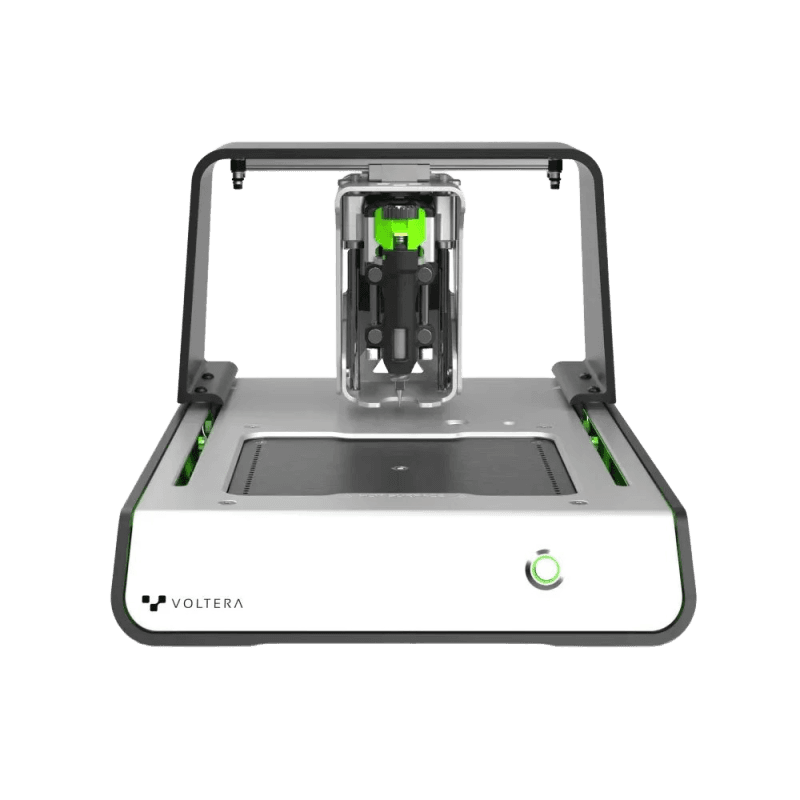
The Voltera V-One is a compact 4-in-1 PCB printer: it prints traces with conductive paint, drills holes, dispenses solder paste, and performs reflow. The manufacturer states that the first prototype can be ready the same day, with a print time of less than an hour. Key specifications include a minimum trace width of 0,2 mm, a build area of 128 x 116 x 3 mm, single- and double-sided boards, and FR1 and FR4 substrates 1–3 mm thick.
Voltera NOVA: flexible and unusual substrates
Voltera NOVA is an automated platform for direct dispensing of functional materials (Direct Ink Write). It works on rigid, flexible, and non-standard substrates, including glass, polyimide, PET, TPU, paper, and fabrics. The manufacturer lists flexible circuits, sensors, antennas, and textile heating elements among its applications. For teams building lightweight electronics, it offers a path to circuits that cannot be fabricated on traditional laminates.
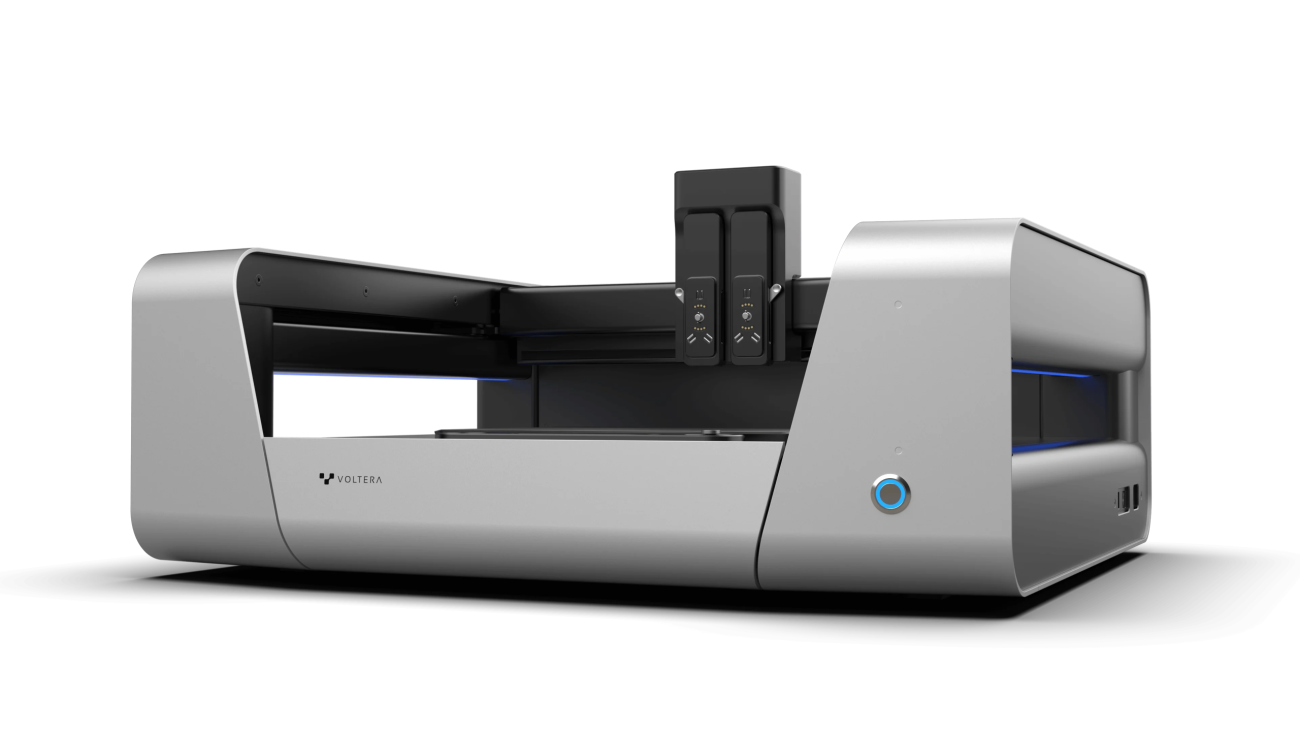
Comparison of both devices according to the manufacturer's data:
| Parameter | Voltera V-One | Voltera NOVA |
|---|---|---|
| Technology | conductive paint printing, paste dispensing, drilling, reflow | Direct Ink Write, closed pressure loop |
| Working area | 128 × 116 × 3 mm | 220 × 300 × 40 mm |
| Minimum line width | Traces | from 100 µm (depending on material and nozzle) |
| Substrates | FR1, FR4 (1–3 mm) | glass, PI, PET, TPU, paper, fabrics |
| Layers | single- and double-sided | up to 4 layers in a stack |
| Best use | prototypes of classic PCBs | flexible circuits, sensors, antennas, heating elements |
Source: Chemikonics product pages. The manufacturer also states that NOVA shortens design iterations by up to 90% and reduces material consumption in the R&D phase by up to 96% (manufacturer data, not our tests).
From CubeSats to Sensors: How These Tools Know Aviation
Voltera publishes customer stories from the space sector. Princeton University students are using the V-One to build CubeSats (miniature satellites), as described in the story " Empowering Space Exploration with the V-One PCB Printer ." According to the V-One website, they've also printed CO₂ sensors on polyamide (Kapton) for NASA. Our conclusion: the "build your own board in an hour" workflow is well-suited to teams building electronics for drones and other aircraft.
An important caveat: V-One and NOVA are prototyping and research tools. Qualifying electronics for aerospace applications is a separate process for the device manufacturer.
What to choose: a quick guide
| Need | Solution | Where to look |
|---|---|---|
| Warm a battery or small surface (5V, USB-C) | BLACKHEATER GPAD 10+ or 11+ | product page |
| Cover a larger area (48V) | BLACKHEATER GPAD 40+ | product page |
| Custom heater or sensor shape | NEOBLACK + Lab Design Service paints | graphene paints |
| Rapid prototyping of FR4 boards | Voltera V-One | Voltera V-One |
| Flexible circuits, sensors, antennas | Voltera NOVA | Voltera NOVA |
Aviation and Defense: A Quick Note
Similar technologies are also of interest to the aerospace and defense sectors. On the BLACKHEATER website, applications in the "Military and Defense" category include anti-icing protection for drones and UAVs, cold battery protection, and thermal decoys. In aviation, protection for leading edges, probes, nacelles, and engines, as well as cabin heating, are also included. We also wrote about the development of space and defense technologies in our report from the SpaceShield Summit in Stalowa Wola . Special projects are discussed on a case-by-case basis.
Frequently Asked Questions
Can the BLACKHEATER foil be powered by a drone battery?
It depends on the design. The GPAD 10+ and 11+ operate at 5V and have a nominal power of 8W, so their consumption must be factored into the drone's energy budget. Power selection and component placement are best discussed at the design stage.
Is the Voltera V-One suitable for avionics?
This rapid prototyping and research tool is used, among other things, in the construction of CubeSats at Princeton University. Qualifying the finished device for flight applications is a separate process.
What substrates can I print flexible circuits on?
Voltera NOVA works on glass, polyimide (PI), PET, TPU, paper and fabrics, while NEOBLACK inks are suitable for paper, PET, Kapton, TPU, PEI and textiles, among others.
How much it costs?
We offer individual pricing, depending on product and quantity. Simply send us an inquiry.
Let's talk about your project
Are you building a drone, unmanned system, or avionics and looking for a solution to handle cold, ice, or longer prototype iterations? Tell us your requirements and we'll find a solution. Contact us via the contact form , at sales@chemikonics.com, or call: +48 573 678 608.